In compliance with current regulations, let us know which audience you belong to:
Cataract & Refractive Surgery
One of the most important risk factors for Dry Eye are some ocular surgeries, such as Cataract and Refractive Surgeries, like nearsightedness (myopia), farsightedness (hyperopia), presbyopia or astigmatism—being LASIK (i.e., laser-assisted in situ keratomileusis) the most popular method applied.
After performing this type of surgery, most patients experience some eye disorders associated to the surgery, especially Dry Eye Disease (DED).
Suggested Protocol
Legend
Single usage
Joint usage
| Application | No. Sittings/Sessions | Frequency | |||||
|---|---|---|---|---|---|---|---|
| DAYS APART, UNLESS SPECIFIED | |||||||
| ApplicationCataract Surgery | Technology | LM® LLLT |
Red
Blue
Yellow
|
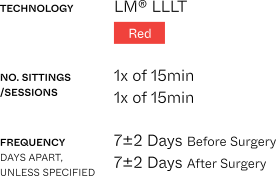
Recommended Protocol > No. Sittings/Sessions 1x of 15min | > Frequency 7±2 Days Before Surgery | ||
| Applicationi.e., Senile & Premium IOLs | Technology |
Red
Blue
Yellow
|
Recommended Protocol > No. Sittings/Sessions 1x of 15min | > Frequency 7±2 Days After Surgery | |||
| ApplicationRefractive Surgery | Technology | LM® LLLT |
Red
Blue
Yellow
|
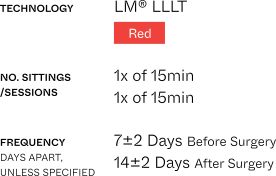
Recommended Protocol > No. Sittings/Sessions 1x of 15min | > Frequency 7±2 Days Before Surgery | ||
| Applicationi.e., LASIK, SMILE | Technology |
Red
Blue
Yellow
|
Recommended Protocol > No. Sittings/Sessions 1x of 15min | > Frequency 14±2 Days After Surgery | |||
Application
> Cataract Surgery
i.e., Senile & Premium IOLs
Application
> Refractive Surgery
i.e., LASIK, SMILE
Scientific Coverage
“Signs and symptoms of dry eye disease (DED) are highly prevalent in the postoperative course of patients undergoing cataract surgery, significantly impairing patients’ satisfaction with surgery and quality of life and vision.
Prophylactic treatment using low-level light therapy could be easily incorporated in the workflow of otherwise healthy patients undergoing senile cataract surgery in order to avoid iatrogenic DED.
GIANNACCARE, Giuseppe. Outcomes of low-level light therapy before and after cataract surgery for the prophylaxis of postoperative dry eye. The British Journal of Ophthalmology, 2023.
“Unresolved ocular surface disease (DED) represents a major risk factor for suboptimal outcomes in refractive surgery. Untreated preoperative dry eye disease (DED) and meibomian glands dysfunction (MGD) can impact the accuracy of refractive calculation and contribute to poor vision outcome. Existing DED, both asymptomatic and symptomatic, can be exacerbated during surgery and lead to postoperative patient dissatisfaction with their cataract procedure.
LABETOULLE, Marc. Making Treatment Decisions For Dry Eye Disease, ESCRS / EuCornea, 2020.
“In people with unstable tear film, there may be variation of more than 1.0D, which can correspond to an error of the same magnitude in lens power calculation and thus significantly impact vision.
ARZEL, Florian. Treatment of meibomian dysfunction by pulsed light and photo-biomodulation, Les Chaiers, 2021.